How many kegs do you actually need for your party?
You've picked the date, booked the venue, and figured out the guest list. Now comes one of the trickiest logistics questions for any wedding, backyard bash, or corporate event: how much beer (or cider, or other draft beverage) should you actually buy?
Get it wrong on the low side, and your bar runs dry two hours before the toasts are even finished. Get it wrong on the high side, and you've spent hundreds of dollars on kegs that go back half full. Neither is a great outcome — so let's break down how to land somewhere in the middle.
Start with our keg calculator
Before you do any manual math, plug your numbers into our keg calculator. Enter your guest count and an estimated number of drinks per guest, and it'll tell you how many kegs you need — along with a breakdown of common keg sizes, from a mini keg all the way up to a full half barrel, and how many 12oz bottles or 16oz pints each one holds. It takes the guesswork out of the sizing math below.
The basic math behind the calculator
If you want to understand what's happening under the hood, the formula is simple:
Total drinks needed = Number of guests × Drinks per guest
From there, divide by how many servings a given keg size holds. A standard half barrel (the "full size" keg you're probably picturing) holds about 124 pints or 165 twelve-ounce servings. A quarter barrel holds roughly half that.
The part people usually get wrong isn't the math — it's the "drinks per guest" number. That depends heavily on your event.
How many drinks per guest should you plan for?
- Short event (2–3 hours, like a cocktail hour or office happy hour): 1–2 drinks per guest
- Standard event (4–5 hours, most wedding receptions and parties): 2–3 drinks per guest
- Longer event (6+ hours) or a crowd that skews toward heavier drinkers: 3–4 drinks per guest
These are starting points, not rules. A daytime corporate mixer will land on the low end. An evening wedding reception with an open bar and a dance floor will land on the higher end.
Choosing what to pour, not just how much
Guest count and hours covered gets you the volume. But a good bar also accounts for variety, since not every guest wants the same thing.
A few practical guidelines:
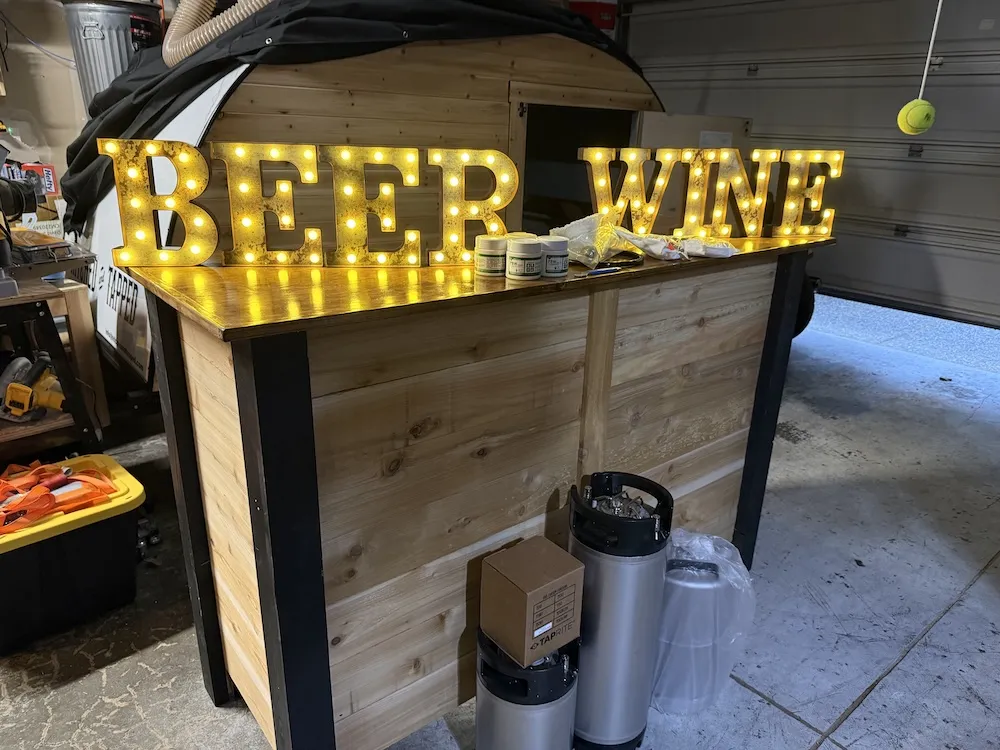
- Offer at least two styles. A light lager and something with more character (an IPA, an amber, or a cider) covers most preferences without overcomplicating your setup. Our trailer holds four full-size kegs, so you have room to mix and match.
- Match the style to the season and crowd. Lighter lagers and ciders tend to perform well at summer outdoor events; heavier styles fit better in cooler months.
- Consider a cider or seltzer option. These tend to appeal to guests who don't drink beer but still want something on tap.
- Ask your caterer or venue what's already planned for wine and cocktails. If there's a separate wine service, you can lean your keg selection more toward beer variety instead of stretching thin trying to cover everything.
Accounting for kids and non-drinking guests
This is the step people forget, and it can throw off your numbers more than you'd expect.
Take your total guest count and separate out anyone who won't be drinking beer or cider: children, designated drivers, guests who don't drink, and anyone who prefers wine or a full cocktail bar instead. Run your keg calculation on the adjusted number, not your total headcount.
A rough guideline:
- Weddings and family events: it's common for kids and non-drinkers to make up 15–30% of the guest list. Subtract that percentage before calculating.
- Corporate events: this can vary widely depending on your company culture — check in with your HR or events contact if you're unsure.
- When in doubt, round down slightly on guest count, not drinks per guest. It's a smaller adjustment and keeps your buffer intact.
If you're serving a mixed crowd, consider offering a non-alcoholic tap option alongside your beer or cider kegs — sparkling water, soda, or a non-alcoholic craft beverage. It's an easy way to make sure everyone has something to grab from the same trailer, and it's one more reason having four taps to work with comes in handy.
A quick example
Say you're planning a 5-hour wedding reception for 120 guests, and about 20% (24 guests) are kids or non-drinkers. That leaves 96 drinking guests. At 3 drinks per guest for a 5-hour event, that's 288 total drinks.
Run 96 guests and 3 drinks per guest through the keg calculator and you'll get a size and quantity recommendation instantly — no spreadsheet required.
The golden rule
As we say on our calculator page: having too little is a party tragedy, but having too much is a waste. When your numbers land between two keg sizes, it's usually worth rounding up slightly rather than risking an early last call — especially for events like weddings where there's no quick trip to restock.
Have questions about sizing your event, or want to talk through attended vs. self-serve options? Give us a call or text and we'll help you plan it out.